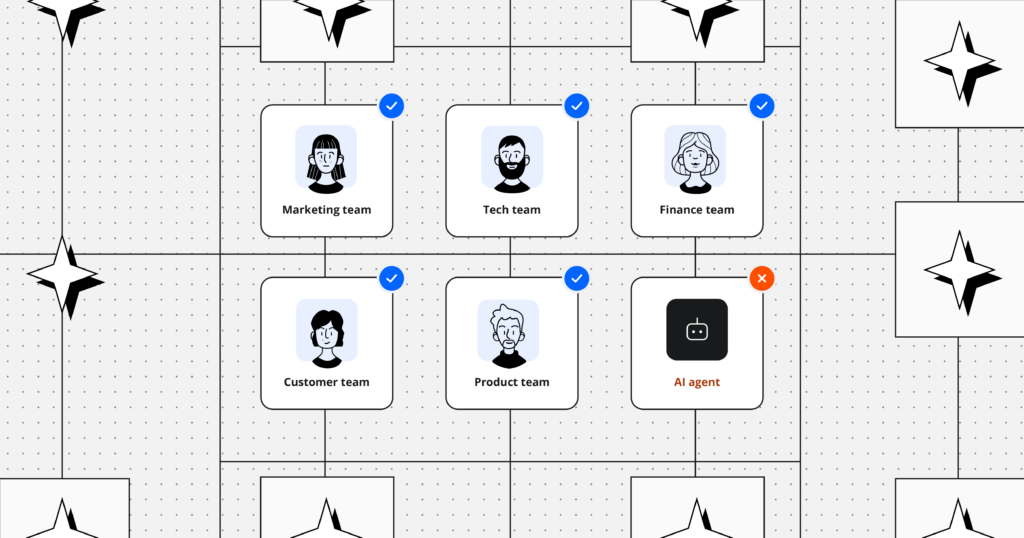
AI agents are consuming more customer data than ever, yet they are rarely trained or aligned with the established security and governance frameworks. While many compliance/security teams default to reactive guardrail filters or outright agent blocking, these are merely band-aids for a foundational flaw. True agentic AI protection starts with one architectural shift: controlling exactly what an agent can see before it acts.
Why Awareness Month Needs an Agent Chapter
Every October, compliance teams run the familiar playbook. Staffs click through at least one fake phishing email, multi-factor authentication gets toggled on, and the corporate intranet fills with password tips, tutorials, and quiz links. The US campaign from CISA and the National Cybersecurity Alliance also rallies under the theme “Don’t Make It Easy for Them“, and ENISA’s European Cybersecurity Month places workplace vigilance at the center.
While staffs are absorbing security knowledges, our new colleague – autonomous AI agents – operate entirely outside your security culture, or they may not get training invite at all.
The scale of this exposure is massive. In Deloitte’s State of AI in the Enterprise 2026 survey of 3,235 business and IT leaders, 74% expect their companies to use AI agents at least moderately by 2027, yet only 21% report a mature governance model for agentic AI Compounding this, a Cloud Security Alliance survey found that 74% of security professionals acknowledge these agents routinely receive excessive, unmapped access permissions.
AI agents are now actively querying data lakehouses, reading support tickets, summarising contracts and calling external models, often with far broader access privileges than the “original” engineer owner who deployed them. They get no compliance module training, and worse, the malicious instructions they follow can arrive hidden inside the very content they were asked to read.
Awareness training assumes an employee reader who can say no
Traditional awareness training assumes an employee reader who possesses a moment of judgment—someone who can spot a spoofed domain and say “no.” An AI agent has no no equivalent checkpoint. Large language models treat instructions buried deep within a document or an email as part of their immediate task, which is why OWASP ranks Prompt Injection as the top threat to LLM applications. The agent’s credentials remain perfectly valid, but its identity is untainted. The data access looks fully authorized; and only the intent has been hijacked.
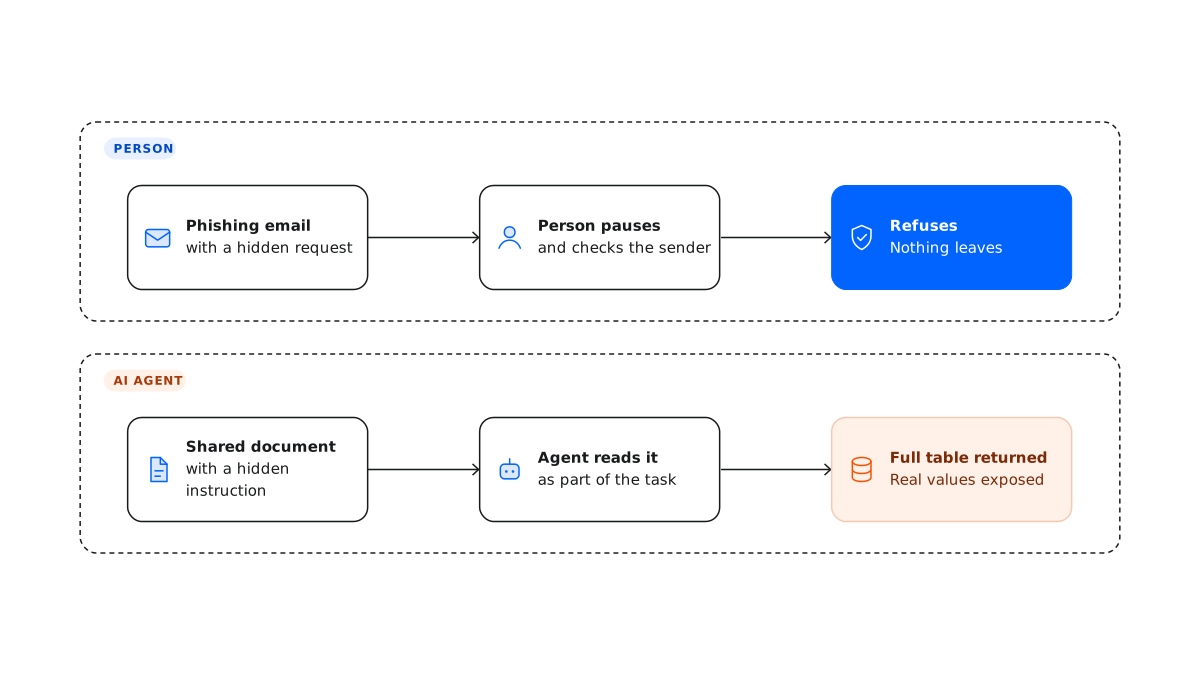
To secure this new architecture, security teams must shift from controlling how an agent behaves to controlling what an agent can actually see.
Three Ways Agents Expose Regulated Data
Live Database Access Turns One Injection into a Full Export
Consider a support assistant connected to the customer database to answer questions and build reports. If an attacker embeds a command in the content the assistant retrieves, requesting the entire customer table, and the agent reads the actual values, one such injection could result in the exposure of thousands of records.
This pattern isn’t theoretical. It has already appeared in production software. The EchoLeak vulnerability in Microsoft 365 Copilot (CVE-2025-32711) allowed a specially crafted email to pull data from a victim’s earlier conversations, with zero clicks. The failure sat upstream of the agent where this data was readable right from the beginning.
Test Environments Copy Production Risk with Less Oversight
Building and evaluating effective AI agents requires highly realistic data, and cloning production data is still the fastest path to obtain it. Consequently, sandbox, dev, and test environments often contain real names, addresses and account numbers, typically with broader developer access and less monitoring than production. These environments are usually treated as temporary, yet the copies they hold can persist long after a project ends.
Prompts Carry Real Values to Third-Party Models
Agents assemble prompts from enterprise data and send them to external models and APIs. Every prompt containing a customer ID, social security number, or health detail moves that sensitive payload entirely outside your security perimeter. After that, it is handling dependss on third-party retention terms and vendor contracts to determine how that data is stored or processed.
A more effective control applies earlier, by asking whether the model requires the real value at all. For most analytical tasks, a consistent substitute is sufficient. A churn model needs to know that two transactions belong to the same customer; the customer’s name adds nothing to that calculation.
Where agents go vs. what agents see
Enterprise data security for the AI era cannot rely solely on the agent tier. While identity governance, scoped credentials, and runtime guardrails are necessary, they can only protect the perimeter of the application. True resilience requires securing the data layer itself.
| Layer | Decides | Enterprise Stack Integration |
| Access control | Which services, identities and agents can reach specific tables, columns and rows | Apache Ranger, Unity Catalog, AWS Lake Formation |
| Agentic protection layer (Discovery +Tokenization+Evidence) | What they read once they arrive: regulated values are found, tokenized and released only by policy | SecureToken Agentic AI Protection |
In this agentic protection model, regulated values are replaced with format-preserving, deterministic tokens before any agent reads them. A tokenized name keeps the structure of a name, and an account number keeps its twelve digits. Because the same input always produces the same token, joins, matching and reporting continue to work on protected data.
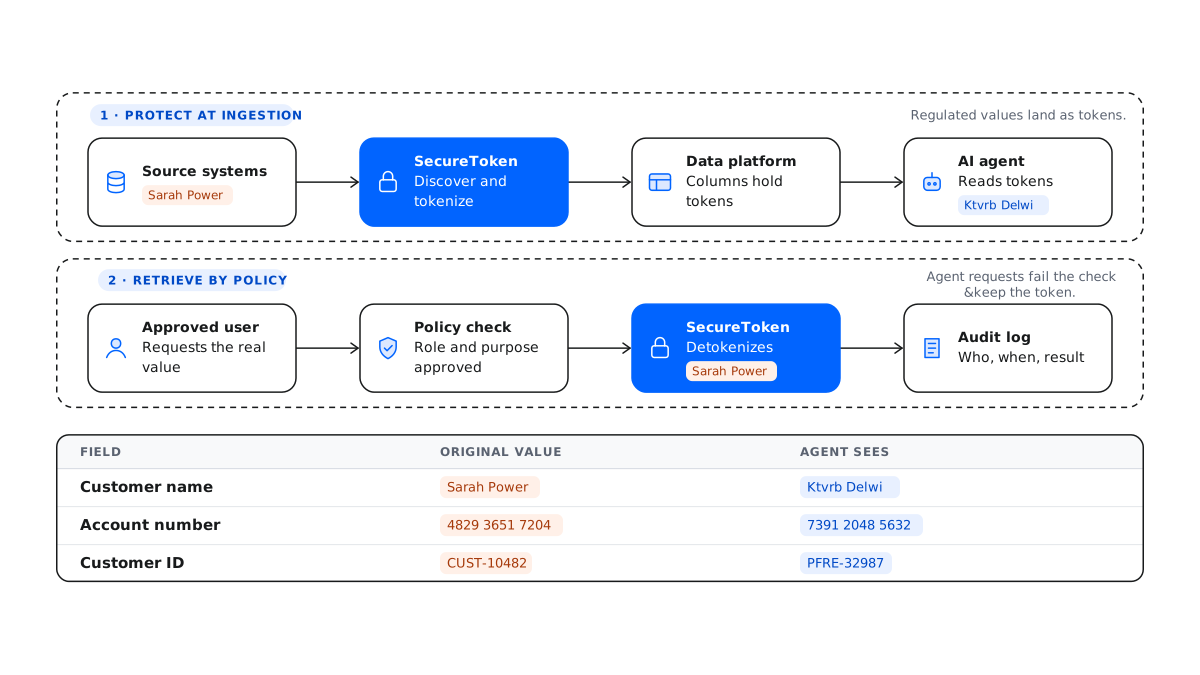
Illustrative. Token formats follow your tokenization policy.
So an agent with full access to the customer database reads “Ktvrb Delwi” in place of “Sarah Power”. If an agent is manipulated via prompt injection or its output history is compromised, the attacker walks away with useless tokens. The real underlying data remains safely with tokenization limiting the blast radius; detokenization occurs only for approved analysts and services, with every single event/release/action cryptographically logged in the portal.
Four practices for an Agent-Ready Data Estate
Just as Cybersecurity Awareness Month encourages core digital hygiene habits for employees , data engineering teams must adopt foundational habits for the data their AI systems touch:
- Detect regulated data continuously: automatically scan your lakeshouse, free-text fields and transactional databases. Protection depends on knowing where regulated fields exist.
- Tokenize as data lands. Applying tokenization as data enters the pipeline means every downstream copy, test environment and agent output inherits protection by default.
- Enforce Zero Trust Protection: Treat plaintext visibility as a rare exception. Restrict detokenization strictly to verified, compliance-approved services in accordance with the industry profile and tokenization policies, generating an immutable audit trail for compliance officers to answer the most rigid compliance question.
- Evaluate Agents on a Tokenized Twin: A tokenized copy of production gives development teams realistic test data and allows repeated evaluation runs with zero real customer data in scope.
These practices complement identity management, monitoring and guardrails. Their purpose is to contain the impact when one of those controls is bypassed.
How Bluemetrix SecureToken Brings Agent-Safe Data
Bluemetrix SecureToken provides the agent-safe data tokenization layer that modern privacy-safe enterprises require. It deploys AI-powered PII discovery to identify and detect regulated fields across the entire corporate footprint, whether they are buried deep in free-text messages, unstructured attachments, system notes, or complex health data formats like HL7/FHIR messages.
Once discovered, SecureToken tokenizes these sensitive attributes in a vaultless, format-preserving state.
This architectural approach ensures that real, underlying data values are strictly decoupled from the workflows running above them since every action runs in place, especially inside the enterprise data platform you already use, on-premises or in the cloud.
Plaintext records are only released when triggered by an explicit, policy-authorised request, generating a tamper-proof log entry for every decryption event to provide complete compliance auditability.
“Every agent we’ve seen in production eventually reads something it shouldn’t. Teams can keep tightening the rules around the agent, or they can change what the agent finds when it gets there. We built SecureToken for the second approach, because it holds even on the day the first one fails.”
— Leonardo Dias, Head of Architect, Bluemetrix
Before October Ends
Awareness Month wraps up on 31 October, and your agents will be back in action on 1 November. Here’s one question worth putting to your team this week is how much real customer data a single manipulated agent could expose today.
For most organisations, the answer points to a contained first step: select one agent workflow approaching production, map the regulated fields it reads, and tokenize them at the source.
Talk to our team about your first agent workflow → Contact us here
Frequently Asked Questions About AI Agent Data Security
How is AI agent data security different from traditional data security?
Traditional controls assume a known user, provide a fixed route to the data, and allow sufficient time for someone to notice any problems. In contrast, agents select their own queries and tool calls at runtime, act on structured or unstructured content—that is to say, free-text messages, notes, attachments, etc.—which the team has rarely vetted, and move far faster than any review process, so protection has to travel with the data itself.
Does tokenization prevent agents from doing useful work?
No. Format-preserving, deterministic tokens keep joins, matching and reporting intact, so agents can analyse tokenized data and return accurate results. Original values are available only to approved users and services.
How does tokenization work with an existing access control framework?
They work together as two layers of defence. Your own access control framework decides who can open the customer database and which fields they can query. Tokenization changes the original values into randmised values with selected fields, for example, Sarah Power is stored as Ktvrb Delwi. So an agent with full permission still reads only tokens. The real name goes back to approved people alone, and every release is logged.
Is tokenization the same as masking?
No. Dynamic masking hides values in query results, and the original values stay in storage. Tokenization replaces the stored values, so copies, exports and agent outputs carry tokens, and an authorised process can release the originals when required. Check out this link to learn more.