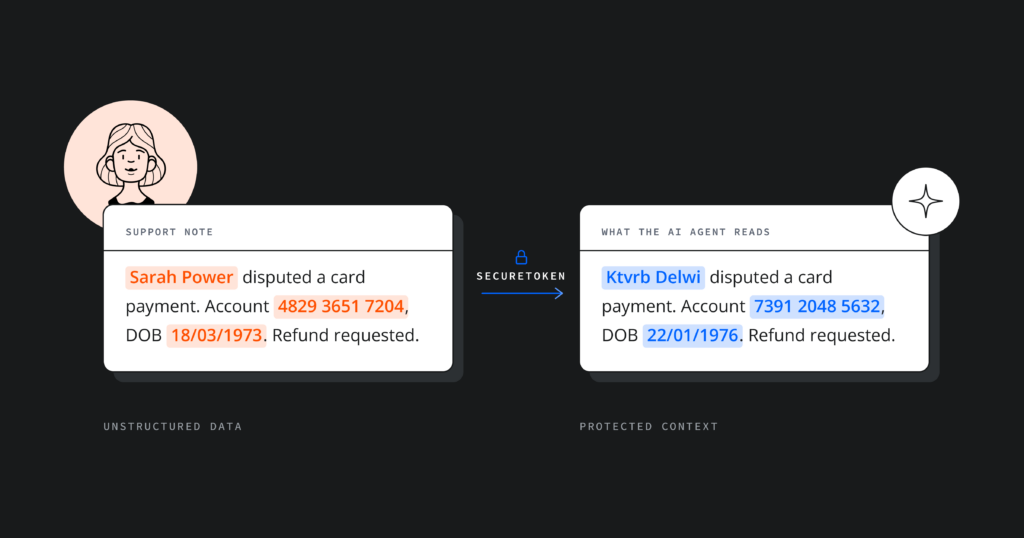
The context AI agents need most often sits in notes, tickets, attachments, and transcripts, and personal data sits inside those sentences. This article covers why teams keep agents away from free text and how to open it up at the data layer.
TL;DR
- AI agents do their best work with the free text around a case. These files usually contain a lot of personal data.
- Column rules in a database look at field names, so a card number inadvertently typed into a date column slips past them. Notes columns in databases also contain lots of PII, and many teams block free text altogether.
- Revoking an agent’s access happens after it has read the data. Protection must come first.
- Finding personal data inside sentences and replacing it in place gives agents the full semantic story while ensuring the PII is protected as per the policy.
Ask a bank’s data team which sources its AI agents are kept away from, and the answer is rarely a table. It is the unstructured data, with personal details sitting inside the content itself.
However, the unstructured data contains the semantic context that the Agents require to deliver high-quality results.
The blocked sources are the ones that explain a case. For example, the structured record says a customer disputed a payment, but the note says the customer was abroad, the card was cloned, and they have already rung twice.
Gartner puts unstructured content at 70% to 90% of organisational data (Gartner, May 2026). Meanwhile, BARC found only 29% of organizations can fully locate their AI-relevant unstructured data (BARC, June 2026). In other words, most agents work from the smaller, tidier slice of what a company knows.
Why column rules miss personal data
Structured data is predictable. A column called account_number holds account numbers, so a masking rule can target it.
Unstructured data, on the other hand, gives no warning. It covers any content without a fixed schema: free text, documents and scanned images, audio and its transcripts, email and chat, and semi-structured messages such as HL7, FHIR and SWIFT. Personal data turns up inside all of it, typed into a sentence, read aloud on a call, printed on a scanned form or tucked into a message segment.
The mix changes by industry. The problem stays the same.
| Industry | Unstructured data | Semi-structured data |
| Banking and payments | Complaint and dispute records, call recordings, KYC documents such as passports and utility bills | SWIFT MT and ISO 20022 payment messages |
| Insurance | Claim descriptions, loss adjuster reports, medical reports attached to claims | ACORD XML claim messages |
| Healthcare | Clinical notes, discharge and referral letters, scanned consent forms | HL7 v2 messages, FHIR resources, DICOM image headers |
| Public sector | Case files, citizen correspondence, scanned application forms | XML and JSON submissions between agencies |
| Telecoms | Support chats, recorded calls | Network and app logs carrying phone numbers and locations |
| Every industry | Email, PDFs, shared drives, chat tools | Application logs, JSON and XML exports, API payloads |
As a result, most teams have kept agents away from free text altogether.
The cost of keeping agents out
Blocking free text is the cautious call, and for a pilot it is often the right one. The trouble starts in production.
An agent that only sees fields gets the outcome and misses the reason. It escalates cases it could have closed. Its summaries skip the one line a reviewer needed. Over time, people stop trusting it and the project stalls. Many times, it looks like a model quality problem. In fact, the real gap is missing context.
We hear it most from regulated banking and healthcare teams. In both, much of what staff knows about a customer only ever lived in a note.
Why protection has to come before the read
There is no shortage of guidance on AI agent risk. The NIST AI Risk Management Framework, ISO/IEC 42001, MITRE ATLAS and the OWASP Top 10 for Agentic Applications cover risk assessment, testing, monitoring and incident response. Forrester expects an agentic AI deployment to cause a public breach in 2026 (Forrester Predictions 2026), so teams are right to use them.
Many of their controls work on the agent itself: test it before release, watch it in production, contain it if it misbehaves. Detection and revocation still come after the agent has read the data. By the time access is cut, the agent may already have summarised it, stored it in memory or sent it to a model API.
Gartner warns against agents able to access sensitive data, take in untrusted content and communicate externally in the same flow (Gartner, April 2026). In particular, free text alone meets two of the three on its own. It holds personal data, and anyone can write into it, including someone attempting a prompt injection.
Protecting the personal data before an agent reads it is the control that acts first. It also fits inside each of the frameworks above, as data minimisation and least privilege applied to what the agent can read.
How to protect PII in unstructured data
Protection belongs at the data layer, before any agent connects. Bluemetrix SecureToken works in three steps.
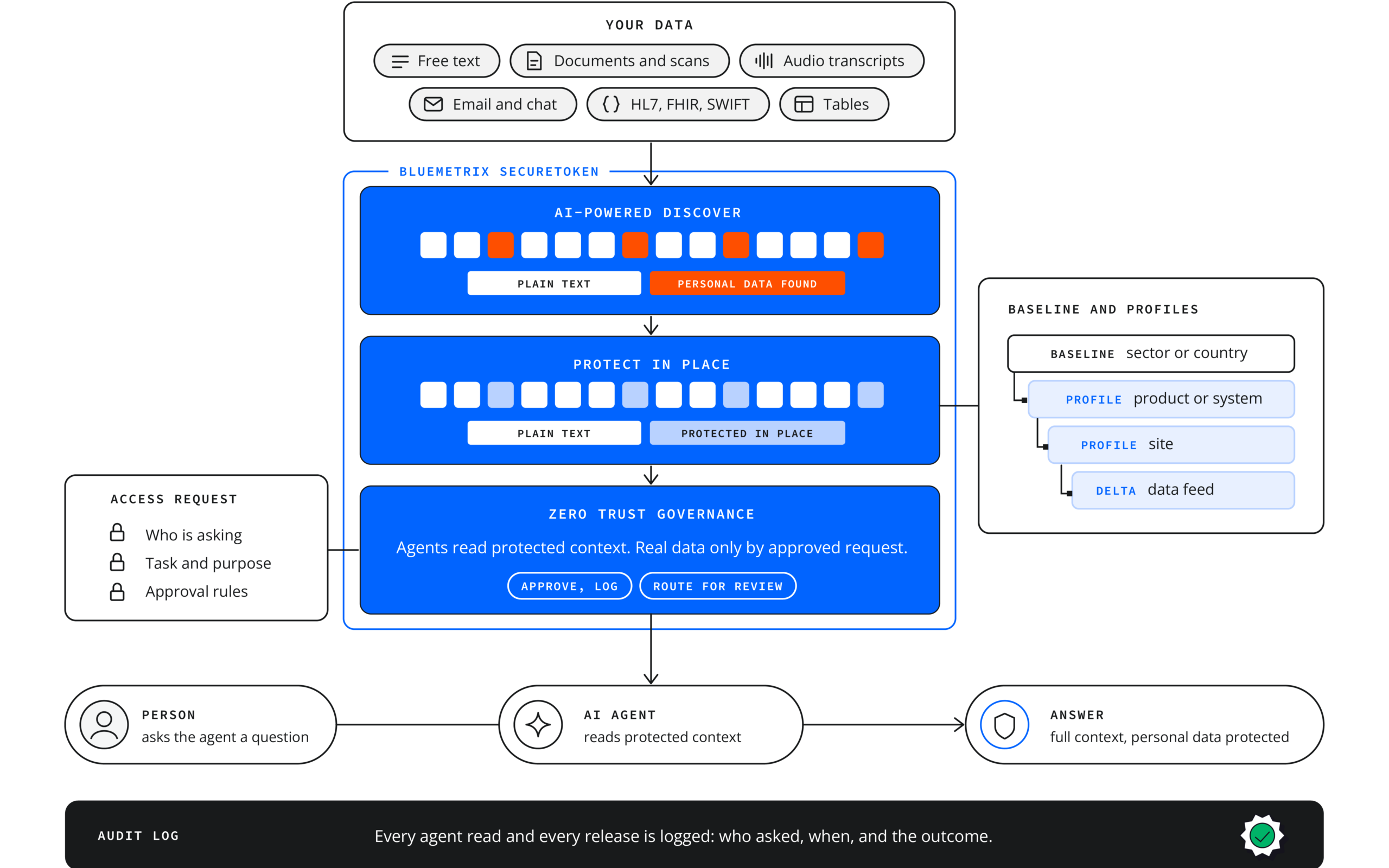
Find personal data inside the free text
AI-powered discovery has to read language, beyond column names and regular expressions. A twelve-digit number after the word “account” is probably an account number. Equally, the same digits in a shipping reference may be something else. AI-powered discovery uses the surrounding words to tell them apart, across every unstructured source, whatever the format.
Run it as data lands because a quarterly scan leaves every new file and message exposed until the next run.
Tokenize it in place
SecureToken swaps each match in place for a substitute of the same shape. A name becomes another name. A twelve-digit account number stays twelve digits.
| Original note | What the agent reads |
| Sarah Power disputed a card payment. Account 4829 3651 7204, customer ID CUST-10482. Refund requested. | Ktvrb Delwi disputed a card payment. Account 7391 2048 5632, customer ID PFRE-32987. Refund requested. |
The sentence reads as it did before, the semantic context is still in place, so the agent can summarise it, classify it and reason over it.
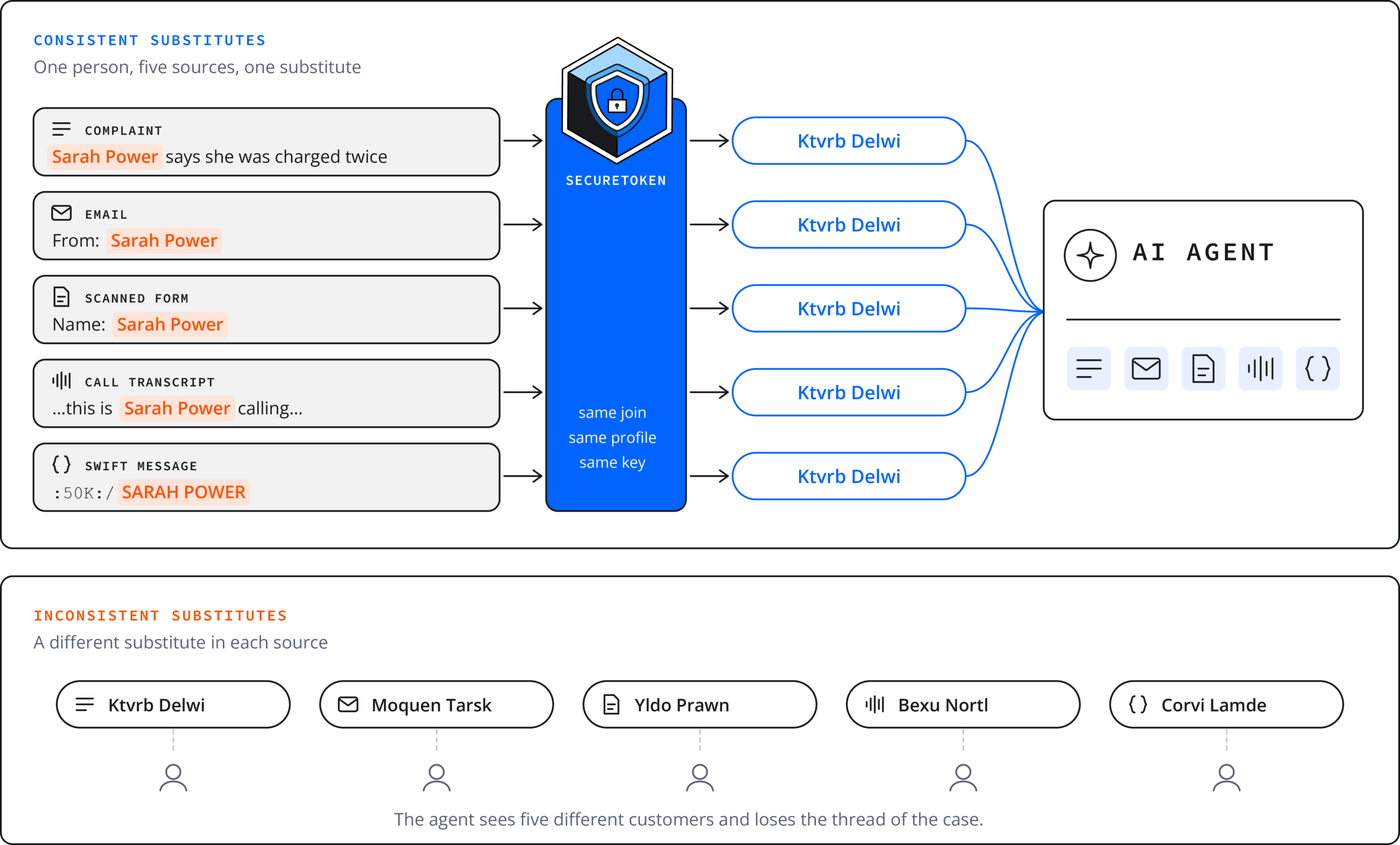
Consistency is the part teams underestimate. For instance, Sarah Power appears in five places across your unstructured data. All five need the same substitute. Otherwise, the agent sees five different customers and loses the thread of the case.
Govern access with zero trust
Zero trust governance in Bluemetrix SecureToken means nobody gets the real data by default, agent or person. Policy checks every request, every time.
Implementation comes in a number of different stages. A baseline Profile sets the shared rules for a sector or country: which data counts as personal, classification of entities, and which protection applies to each type, etc. A policy is a named set of tokenization rules for one data entity, such as a card number or an employee name: which method, which key, what format is used, and who may reverse it.
In a bank, that could be one group baseline, one profile per core banking or card platform, one per country or business line, and a small delta per data feed, such as a SWIFT or card transactions feed. Each layer states only what is new. Everything else is inherited. Other industries layer it differently, and the principle stays the same.
Specifically, some tasks need the original data: a callback, a refund, a clinical follow-up. Such rehydration requests go through a policy gate on the MCP server, with a person approving if the rules require one.
The audit log portal records each rehydration request by who asked, when, and the outcome. Six months later, when an auditor asks what the agent could see, there is an answer.
Fair concerns about Bluemetrix SecureToken
Technical readers tend to raise the same four concerns:
“Discovery will miss things.”
It can. No discovery system will ever deliver a 100% successful result on every data corpus it processes.
Bluemetrix SecureToken maximises the accuracy of your discovery algorithms, and it does this by giving the customer the ability to add multiple different models to run on the discovery process, feeding into an Arbitration layer which you can customise to select the most accurate result.
When the models disagree on a result or are unsure of one, SecureToken also plans for that: the match goes to a person, who makes the call. Before go-live, measure recall per type of personal data on a sample of your own data.
“The surrounding details can still identify someone.”
Swap the name and the account number, and “the only customer at the Ballina branch with a 2019 Tesla” may still point to one person. Two things close the gap. Profiles can cover indirect identifiers too, such as dates of birth, postcodes and vehicle registrations.
However, for very small datasets (e.g. people with a rare disease) it may be possible to identify the subject matter with the addition of extra data.
“If the keys leak, the protection can be reversed.”
A fair worry for any reversible protection, and the reason SecureToken follows standard envelope encryption.
Two keys work together: a data key protects the data, and a master key protects the data key. The encrypted data key is the only key kept in storage, and on its own it unlocks nothing. A leaked master key unlocks nothing either, because its only job is to protect the data key. Reversing the protection takes the master key, the encrypted data key and the exact profile settings used to protect that data.
Inside SecureToken, the only route back is an approved release, and the audit log records every release. Keys are also scoped by domain, so finance and HR use separate keys, and the agent never holds one.
“Our regulator still treats this as personal data.”
Often, yes. Each regime takes its own view of protected data, and tokenization helps under each one differently.
An AI data protection layer reduces exposure under every one of these. Map it to the rules your teams already follow, alongside access control and logging.
Questions to ask before your next agent goes live
- Which unstructured sources do your agents skip today, and which decisions would improve with them?
- How well does discovery perform on your own data, in your own languages and formats?
- Which tasks need the original details, and who signs off a release?
- If an agent misbehaved tomorrow, could you show to an auditor which personal data it saw?
Customers explain themselves in unstructured data. Agents can work with it once the personal details inside are protected.
Protect regulated data in free text with SecureToken here.
Frequently asked questions
SecureToken is the data protection layer between your data and AI agents. It runs inside your existing data platform, on-premises or in the cloud, including on Cloudera alongside Apache Ranger. Data is protected as it lands, so agents, retrieval pipelines, and tools read protected data through the connections they already use.
Scanning happens when data lands, so the cost sits in the pipeline. At query time, the data the agent reads is already protected. Rehydration requests add a step, though only for the tasks that need the original details.
It helps under GDPR, DORA, EU AI Act, NIS2, HIPAA and PCI DSS, each in a different way (see the list below). No single control meets a regulation on its own, so map it with your compliance team alongside access control and logging.
GDPR: Tokenized data counts as pseudonymised and stays personal data (Recital 26). It is a recognised safeguard and helps with data minimisation.
DORA: EU financial entities must test their ICT systems regularly, and AI agents are part of that estate. A tokenized digital twin of production lets teams run those tests on realistic data, keeps customer data out of test environments, and records every result as evidence.
EU AI Act: Article 4a, added by the 2026 Digital Omnibus, names pseudonymisation among the safeguards for special category data used to detect bias in high-risk AI systems.
NIS2: Article 21 lists cryptography and access control among the security measures for essential and important entities.
HIPAA: Protected health data keeps its safeguards unless it meets the de-identification standard.
PCI DSS: Systems that only handle tokenized card data can fall outside PCI scope.
Accuracy depends on your data. Test discovery on a sample of your real data, per data type and per language, and review a share of results by hand during the pilot.
Only through an approved release, and each one is logged.